As we move from Christmas into the season after the Epiphany, I am reminded of the words of the prophet Isaiah:
The people who walked in darkness
have seen a great light;
those who dwelt in a land of deep darkness,
on them has light shined. (Is 9:2 NRSV)
Isaiah goes on to say:
For to us a child is born,
to us a son is given;
and the government will be upon his shoulder,
and his name will be called
“Wonderful Counselor, Mighty God,
Everlasting Father, Prince of Peace.”
7 Of the increase of his government and of peace
there will be no end,
upon the throne of David, and over his kingdom,
to establish it, and to uphold it
with justice and with righteousness
from this time forth and for evermore.
The zeal of the Lord of hosts will do this. (Is 9:6-7)
These words are repeated frequently in Christian churches throughout the Advent and Christmas season, as Christians believe, because of the Gospel of Matthew, that Isaiah is predicting the birth of Jesus 8 centuries after Isaiah first spoke them. In the United States, very often we apply Isaiah’s prophecy to our government, and assume that as a “Christian” nation, these words must be describing us and our future, which will be a golden future that lasts forever.
We often stop reading Isaiah at the good parts, and fail to continue reading the parts that would require us to change the way we do business–and I use that term advisedly. For example, Isaiah 10, still part of the same oracle, continues:
Ah, you who make iniquitous decrees,
who write oppressive statutes,
2 to turn aside the needy from justice
and to rob the poor of my people of their right,
that widows may be your spoil,
and that you may make the orphans your prey!
3 What will you do on the day of punishment,
in the calamity that will come from far away?
To whom will you flee for help,
and where will you leave your wealth,
4 so as not to crouch among the prisoners
or fall among the slain?
For all this his anger has not turned away;
his hand is stretched out still.
I started the first draft of this post in December of 2016, shortly after the Presidential election. I am struck by how apt it still is during this year’s transition from Christmas to the season after the Epiphany, as we hear about tightening up eligibility requirements for access to SNAP (food stamps) and other policies designed to help poor people in our society, along with the increasing gap between the wealthiest in our society and even those of the middle class. The Economic Policy Institute has conducted a 40-year review of the change in income for the top 10% of people in the country, contrasted with the bottom 90%. The disparity should make us pause and consider whether we are really just about every person for her- or himself, or do we want to have what Burton L. Mack calls a “common good” society? (See his most recent book, Critical Times for America: The Politics of Cultural Amnesia, for his own take on how things have changed since the 2016 elections.) If we are part of the Judeo-Christian religious tradition, do we take seriously God’s repeated insistence that how we treat the least in society is the performance standard against which we shall be judged when God calls us to account? (See, for example, Is. 56, Is. 58, Amos 5, and Matthew 25:31ff.)
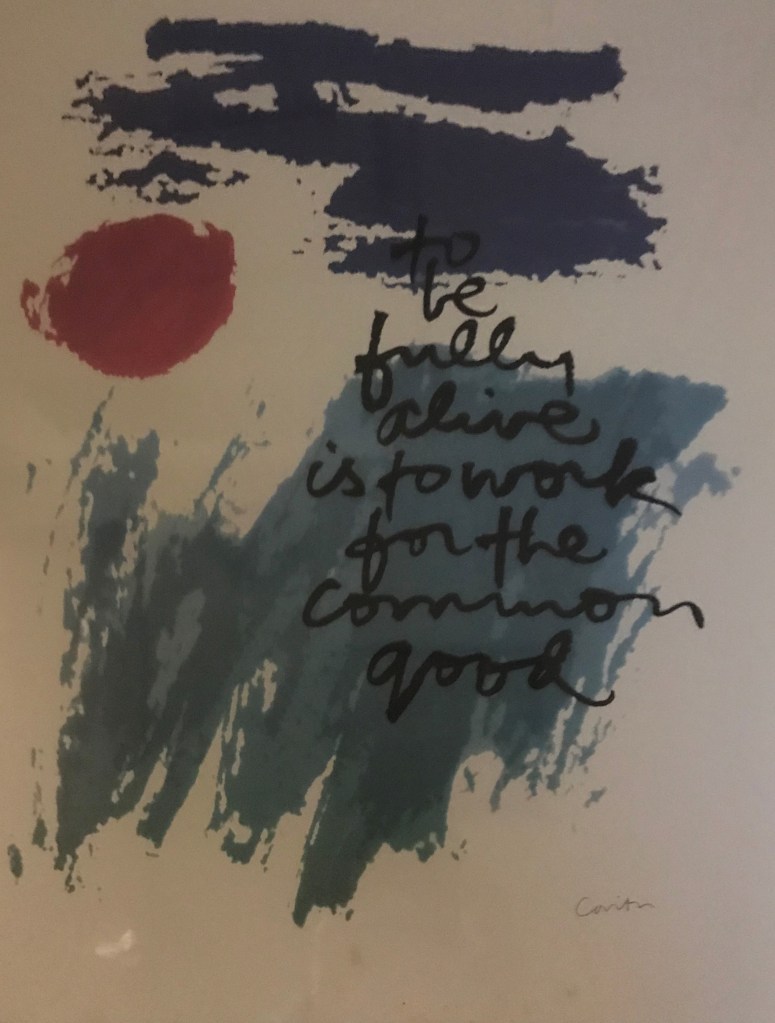
In my office is a print of a very famous Sister Corita Kent art work, which says, ‘to be fully alive is to work for the common good.” It reminds me, in what seem like dark times in our world and in our nation, that each of us has the opportunity to choose, in every moment of our lives, whether we will be light in the darkness, and whether we will be fully alive, by working for the common–and not just our own–good. In 2020, I hope you’ll join me in working to be light and alive. ~Natalie
 Policy and Religion